Added sugars became a required line on the Nutrition Facts label with the 2016 update. It's the only sugar line with a % Daily Value. It's also the line small producers most often get wrong, because the question isn't how much sugar is in the food. It's where the sugar came from.
Total sugars vs added sugars
Total Sugars includes every sugar in the food: those naturally present in fruit, milk, and vegetables, plus any that were added. Added Sugars is a subset of that number. It's indented beneath Total Sugars and written as:
> Includes 10 g Added Sugars — 20%
Added sugars has a Daily Value of 50 g for adults and children 4 and older, and 25 g on labels for children 1–3. Total sugars has no Daily Value.
What FDA counts as added sugars
Under 21 CFR 101.9(c)(6)(iii), added sugars are sugars that are added during processing, or packaged as such. They include:
- Free sugars, meaning mono- and disaccharides like table sugar, brown sugar, and dextrose
- Sugars from syrups and honey: maple syrup, corn syrup, agave, molasses, and so on
- Sugars from concentrated fruit or vegetable juices, beyond what the same volume of 100% juice of that type would contain
If you stirred it in to sweeten the food, it almost certainly counts.
What doesn't count
- Sugars naturally present in whole fruit, vegetables, milk, and other ingredients, such as the lactose in milk or the fructose in bananas
- 100% fruit or vegetable juice sold as juice, and juice concentrated from 100% juice
- Fruit juice concentrates used to make the fruit component of standardized jams, jellies, and preserves, or of fruit spreads
- Juice concentrate used for Brix standardization, or toward the total juice percentage claim
The jam rule matters for cottage producers. In a standardized jam, the fruit component isn't added sugar, but the sugar you add is.
How the line looks on the label
- Indented under Total Sugars
- Begins with "Includes", as in "Includes 12 g Added Sugars"
- Shows a %DV
- Uses the same rounding as other sugars: under 0.5 g is declared as 0 g, and amounts are rounded to the nearest gram
If a product has less than 1 gram of added sugars per serving and makes no claims about sugars or sweeteners, the added sugars line isn't required. In that case, FDA requires the statement "Not a significant source of added sugars" at the bottom of the nutrient table, unless you're using the simplified format.
Honey, maple syrup and other single-ingredient sugars
A jar of pure honey would otherwise have to say "Includes 17 g Added Sugars", even though nothing was added to the honey. FDA's 2019 final guidance on single-ingredient sugars and syrups addresses this. Pure honey, maple syrup, and other single-ingredient sugars and syrups:
- Don't declare the gram amount of added sugars
- Do declare the %DV for added sugars
- Mark that %DV with a symbol, such as †, that leads to a footnote explaining how much a serving adds to the diet. For example: "† One serving adds 17 g of sugar to your diet and represents 34% of the Daily Value for Added Sugars."
The same guidance covers certain dried cranberry and cranberry juice products. If you sell honey or maple syrup, set up your label this way. Our standard vertical format supports the footnote.
Calculating added sugars for a recipe
You can't lab-test added sugars. A lab measures total sugars, and can't tell whether a sugar molecule came from an apple or a bag. So added sugars always come from your recipe records:
- List each sweetening ingredient: sugar, brown sugar, honey, syrup, chocolate chips (they contain added sugar), sprinkles, and so on.
- Find the sugar content of each from supplier specs or the USDA database.
- Add them up for the batch, then divide by the number of servings.
- Round to the nearest gram.
Keep these records. FDA says manufacturers must make records available to verify added sugars declarations where a lab can't measure them.
Fermentation, baking and browning
Sugars change during processing. Yeast consumes some sugar in bread, and the Maillard reaction uses some during baking. FDA's rules allow the added sugars declaration to reflect what's in the finished food, if you have records showing the reduction. Without those records, most small producers simply declare the amount added, which is the conservative choice.
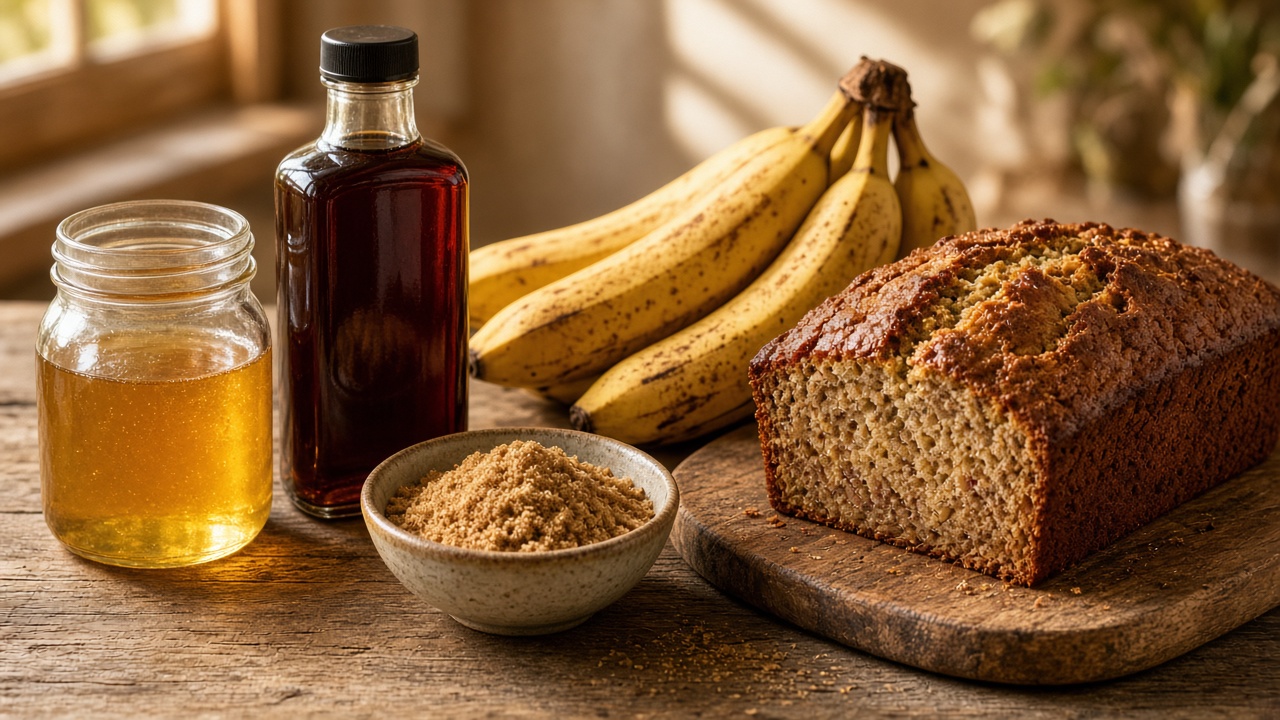
Worked example: banana bread
Say a loaf of banana bread contains:
- 3 ripe bananas: natural sugar, so not added
- 150 g white sugar: added
- 2 tbsp honey (about 34 g sugar): added
Total added sugar for the loaf is about 184 g. Cut into 10 slices, that's about 18 g per slice, or 36% DV (18 ÷ 50 × 100). Total sugars would also include the banana sugars.
Added sugars and "no added sugar" claims
"No added sugar" and "without added sugar" are regulated claims. Under 21 CFR 101.60(c)(2), you can only use them if:
- No sugar, or ingredient containing sugars that functionally substitutes for added sugar, was added during processing or packaging (no honey, no fruit juice concentrate used as a sweetener)
- The product doesn't contain an ingredient that has added sugars, such as jam or dried fruit with sugar
- Processing doesn't raise the sugar content above what the ingredients naturally contain
- The food it resembles normally contains added sugars
Unless the food is also "low calorie" or "reduced calorie", the label must say it isn't one, and direct consumers to the Nutrition Facts panel.
Making the claim also means you need a full Nutrition Facts panel, whatever exemption you'd otherwise have.
Common added-sugar mistakes
- Counting fruit sugar from whole bananas or raisins as added sugar. It isn't.
- Forgetting the sugar inside ingredients: chocolate chips, sprinkles, glazes, sweetened dried cranberries.
- Listing honey's gram amount on a pure honey jar instead of using the footnote approach.
- Rounding added sugars above total sugars. Added sugars can never be larger.
Added sugars on labels for young children
On labels for children 1–3, the added sugars Daily Value is 25 g, half the adult figure. The same 9 g of added sugar that's 18% DV on an adult label is 36% DV on a toddler label. On labels for infants through 12 months, added sugars are still declared in grams, but no %DV is shown. FDA's infant rules leave the %DV out for sugars, sodium, and several other nutrients. Our children 1–3 and infant formats apply these rules.
Frequently asked questions
What counts as added sugars on a nutrition label?
Sugars added during processing or packaged as such: table sugar, syrups, honey, and sugars from concentrated juices beyond what 100% juice would contain.
What is the Daily Value for added sugars?
50 g for adults and children 4 and older, and 25 g on labels for children 1–3.
Does honey have to list added sugars?
Pure, single-ingredient honey declares the %DV for added sugars with a footnote symbol, but not a gram amount, under FDA's 2019 guidance.
Can a lab measure added sugars?
No. Labs measure total sugars. Added sugars come from your recipe and supplier records.