Serving size causes more labeling errors than anything else on the Nutrition Facts panel. The reason is simple. It feels like a judgment call, and it isn't. FDA sets a Reference Amount Customarily Consumed (RACC) for every food category in 21 CFR 101.12, and the rules in 21 CFR 101.9(b) tell you how to turn that reference amount into the serving size printed on your label.
Get the serving size right, and every number below it is right. Get it wrong, and every calorie, gram, and %DV is wrong with it.
What RACC means
The RACC is the amount of a food people typically eat at one time, based on national food consumption surveys. The 2016 update revised several RACCs to reflect how people actually eat. That's why a soda serving is now 12 fl oz, and an ice cream serving is 2/3 cup.
A few RACCs from the 101.12 table:
| Product category | RACC |
|---|---|
| Cookies | 30 g |
| Brownies | 40 g |
| Breads (not sweet quick breads), rolls | 50 g |
| Biscuits, croissants, scones, tortillas | 55 g |
| Bagels, muffins (not English muffins) | 110 g |
| Cakes, mediumweight (e.g., cupcakes, most iced layer cakes) | 80 g |
| Cakes, heavyweight (e.g., cheesecake, fruit cakes with ≥35% fruit/nuts) | 125 g |
| Pies, cobblers, pastries | 125 g |
| Nuts and seeds | 30 g |
| Honey, jams, jellies, fruit butters | 1 tbsp |
| Hard candies, breath mints | 2 g |
| Yogurt | 170 g |
| Ice cream and frozen desserts | 2/3 cup |
| Beverages (carbonated and non-carbonated) | 360 mL (12 fl oz) |
Always look up your exact category. "Cake" alone covers three different RACCs, depending on weight class.
Step 1: find your product category
Find the line in 101.12 that matches your product most closely. Use the most specific one. If nothing fits exactly, use the category for the most similar food. If you're truly stuck, FDA accepts petitions and inquiries. For most small producers, the table covers the product.
Step 2: apply the discrete-unit rules
For products that come in individual pieces, such as cookies, muffins, rolls, or sliced bread, 21 CFR 101.9(b)(2)(i) sets the serving size by comparing one piece with the RACC:
- One piece weighs 50% or less of the RACC: the serving is the number of whole pieces closest to the RACC. A 12 g cookie (RACC 30 g) becomes "3 cookies (36 g)" if three is closest. In this case it is, versus two at 24 g.
- More than 50% but less than 67%: you may choose one piece or two.
- 67% or more, but less than 200%: the serving is one piece. A 45 g cookie is "1 cookie (45 g)".
- 200% to 300%: the serving is the amount closest to the RACC, and you must add a second column showing the whole piece. A 100 g bakery cookie gets a per-serving and a per-cookie column.
Large items you slice: cakes, pies, pizza
For large items that are normally divided, 101.9(b)(2)(ii) sets the serving as the fraction of the item that comes closest to the RACC. FDA's examples include 1/12 cake, 1/8 pie, and 1/4 pizza.
Take a whole fruit pie that weighs 1,000 g. With a 125 g RACC, the closest fraction is 1/8 (125 g), so the label reads "1/8 pie (125 g)".
Single-serving packages and the 200% line
A package that holds less than 200% of the RACC is treated as a single serving. You label the whole package as one serving, even if someone might split it.
A 20 fl oz soda (about 591 mL, or roughly 164% of 360 mL) is one serving. FDA allows an optional extra column for packages between 150% and 200% of the RACC, showing the amount per RACC-sized portion.
When you need a dual-column label
For packages containing at least 200% and up to 300% of the RACC, FDA requires a dual-column label: one column per serving and one per package. A 24 oz bottle of juice, for example, holds 720 mL, which is 200% of the RACC. Some exceptions apply, such as products that need further preparation, or packages too small for a dual-column layout. Our dual-column guide covers the decision in detail. The builder has a per-serving and per-container format ready to use.
Writing the serving size statement
Serving size is written in a common household measure, followed by the metric amount in parentheses:
- "1 cookie (30 g)"
- "2 slices (56 g)"
- "1 tbsp (21 g)"
- "1 cup (240 mL)"
Use cups, tablespoons, teaspoons, pieces, slices, or fractions where they fit. Use ounces only when nothing else works. On the current label format, the serving size line is in bold, in larger type than most of the panel.
Servings per container and rounding
Divide the net quantity by the serving size, then round:
- Generally to the nearest whole number
- Between 2 and 5 servings, to the nearest 0.5
- Precede the number with "about" when it isn't exact, as in "about 9.5 servings" or "about 12 servings"
Random-weight products, such as a block of cheese sold by weight, may say "varied".
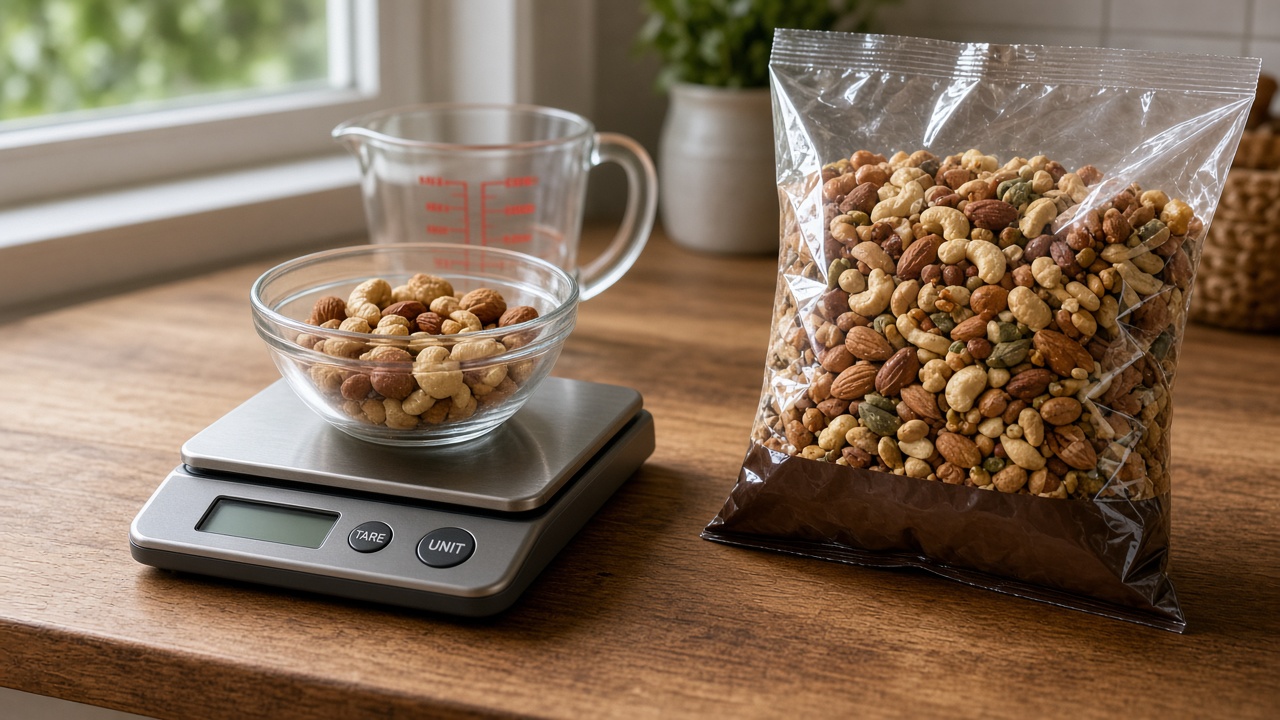
Worked example: a bag of mixed nuts
Nuts have a RACC of 30 g. For a 227 g (8 oz) bag:
- Serving: "1/4 cup (30 g)". Measure your own product to find the cup amount that weighs 30 g.
- Servings: 227 ÷ 30 = 7.6. That's above 5, so round to the nearest whole number: "about 8 servings".
A quick check like this is why it's worth working through the numbers once by hand before trusting any tool.
Why this matters for claims
Nutrient content claims are often judged per RACC, not per labeled serving. Change your serving size to make a claim fit, and you may still fail the claim test. See our guide to the FDA nutrition label requirements for how claims trigger labeling.
Common serving-size mistakes
- Using your recipe yield. "This recipe makes 16 brownies" says nothing about the RACC. Weigh a brownie and apply the discrete-unit rules.
- Picking the wrong cake category. A cupcake is mediumweight (80 g). Cheesecake is heavyweight (125 g). Angel food is lightweight.
- Forgetting the household measure. "40 g" by itself isn't a valid serving statement. It should be "1 bar (40 g)" or "1/3 cup (40 g)".
- Labeling a 1.5-serving package as 1.5 servings. A package under 200% of the RACC is a single serving.
- Rounding servings to the half above 5. The 0.5 rounding applies only between 2 and 5 servings.
Frequently asked questions
What is RACC on a nutrition label?
RACC stands for Reference Amount Customarily Consumed. It's the amount of a food people typically eat at one time, set by FDA in 21 CFR 101.12 for each food category. You use it to set your labeled serving size.
How do I calculate the serving size for cookies?
The RACC for cookies is 30 g. If one cookie weighs 50% or less of that, the serving is the number of whole cookies closest to 30 g. If it weighs 67% or more but less than 200%, the serving is one cookie.
When is a package a single serving?
When it contains less than 200% of the RACC. The whole package is labeled as one serving.
When is a dual-column label required?
When a package contains at least 200% and up to 300% of the RACC, unless an exception applies. You show both per serving and per package.