
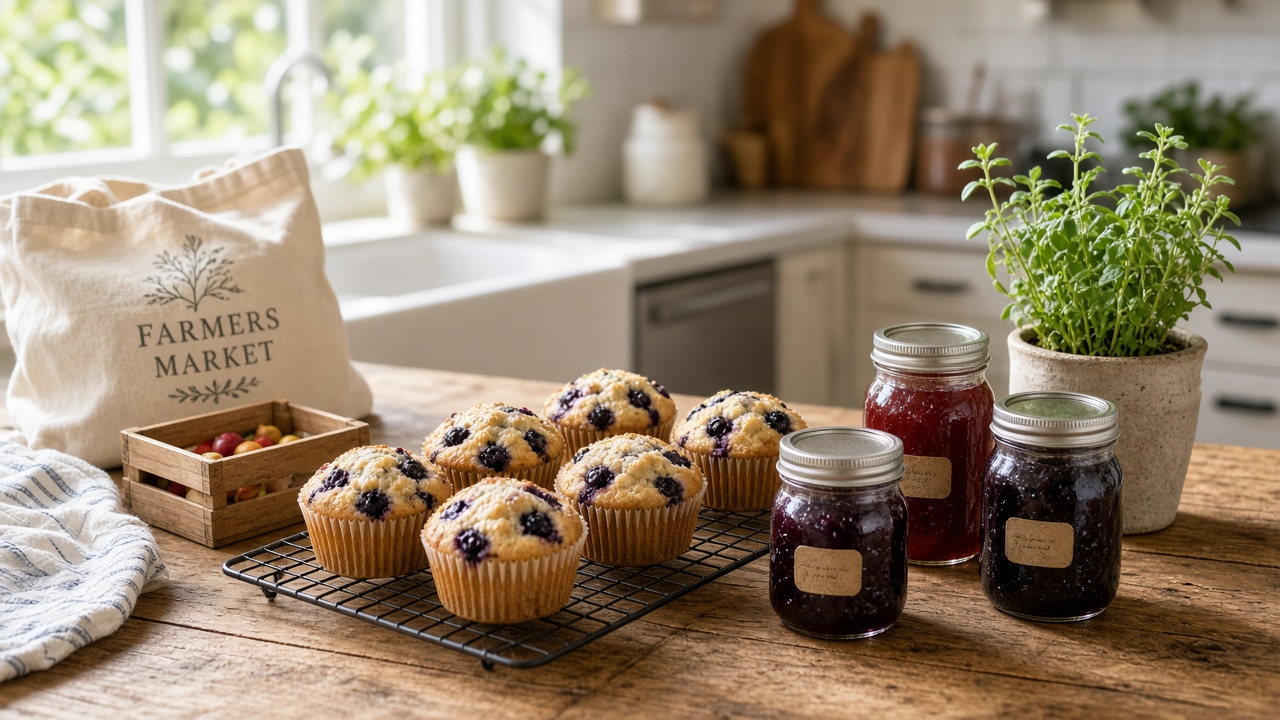
Indiana now has two legal paths for selling food you make at home. The older home-based vendor law covers shelf-stable foods. House Enrolled Act 1424, effective July 1, 2026, created a broader homestead vendor / small farm exemption. The Indiana Department of Health (IDOH) published guidance on it in May 2026. Choose the path that fits your products, because the labels are different.
Track 1: Home-based vendor (IC 16-42-5.3)
Who and what: an individual making non-TCS foods in their primary residence. Examples include baked goods without cream fillings, candy, jams and jellies, dried fruit, granola, and roasted coffee, per Purdue Extension guidance.
Training: a food handler certificate from an ANSI-accredited program. Purdue notes it's valid for three years.
Selling: - In person, by phone, or online - Delivered in person, by mail, or by carrier, but only within Indiana - No state sales cap
Label: 1. Producer's name and address 2. Common name of the product 3. Ingredients, in descending order by weight 4. Net weight or volume 5. Date the product was processed 6. In at least 10-point type: "This product is home produced and processed and the production area has not been inspected by Indiana Department of Health. NOT FOR RESALE."
Track 2: Homestead vendor or small farm (IC 16-42-5.4, from July 1, 2026)
Who and what: HEA 1424 covers a homestead vendor or small farm owner selling food produced on their property. Allowed products include:
- Prepared foods
- Baked goods and candy
- Produce
- Sweeteners
- Fruit spreads
- Meat products from animals raised on the property, processed under Indiana's meat and poultry rules (IC 15-17-5)
Federal USDA-FSIS rules may still apply to meat. Check before you sell any.
Sales cap: $1.5 million in gross annual sales.
Selling: - From the property and at farmers' markets - Online - By delivery to the end consumer - Shipping is allowed in sealed packaging, within Indiana only - A food handler certificate is required if you ship or deliver
Local rules: HEA 1424 says state agencies and local governments can't be more restrictive than the act.
Label: 1. Vendor's name and address 2. Ingredients 3. A product description 4. Allergens the product may have come into contact with 5. In at least 10-point type: "This product was produced by a homestead vendor or the owner of a small farm that is exempt from government licensing and inspection."
Which track should you use?
| If you… | Consider |
|---|---|
| Bake cookies and make jam in town, with no farm | Home-based vendor |
| Raise animals or grow produce and want to sell meat or prepared foods from your property | Homestead vendor |
| Expect more than modest sales, or want to sell meals | Homestead vendor, after confirming with IDOH |
The two labels use different wording. Don't mix them.
Nutrition Facts
Neither Indiana track adds its own Nutrition Facts requirement. The federal rule still applies: claims like "lean" or "high protein" on a homestead meat product, or "low sugar" on a baked good, bring in the full federal panel. Meat sold under federal rules has its own labeling regime. For products with several forms, such as a "raw" and "cooked" mix, see the two-forms dual column format.
Official sources
- IDOH — Homestead and small farm guidance (May 26, 2026, PDF)
- Purdue University — Home-Based Vendors
- HEA 1424 (2026) enrolled text (PDF)
Label formats for Indiana
Indiana home food questions
What is Indiana's new homestead vendor law?
HEA 1424, effective July 1, 2026. It lets homestead vendors and small farm owners sell food produced on their property, including some meat products, with a $1.5 million gross sales cap and no state licensing.
Can I ship home-based vendor products in Indiana?
Yes, by mail or carrier, but only to buyers within Indiana.
What does the Indiana home-based vendor label say?
"This product is home produced and processed and the production area has not been inspected by Indiana Department of Health. NOT FOR RESALE." in at least 10-point type.
Do I need a food handler certificate?
Yes for home-based vendors. Homestead vendors need one if they ship or deliver.